How to solve logic puzzles without guessing
A logic puzzle that is properly made can be solved without guessing. What it takes is a fixed order of work and the will to leave a cell empty until you know what goes in it.
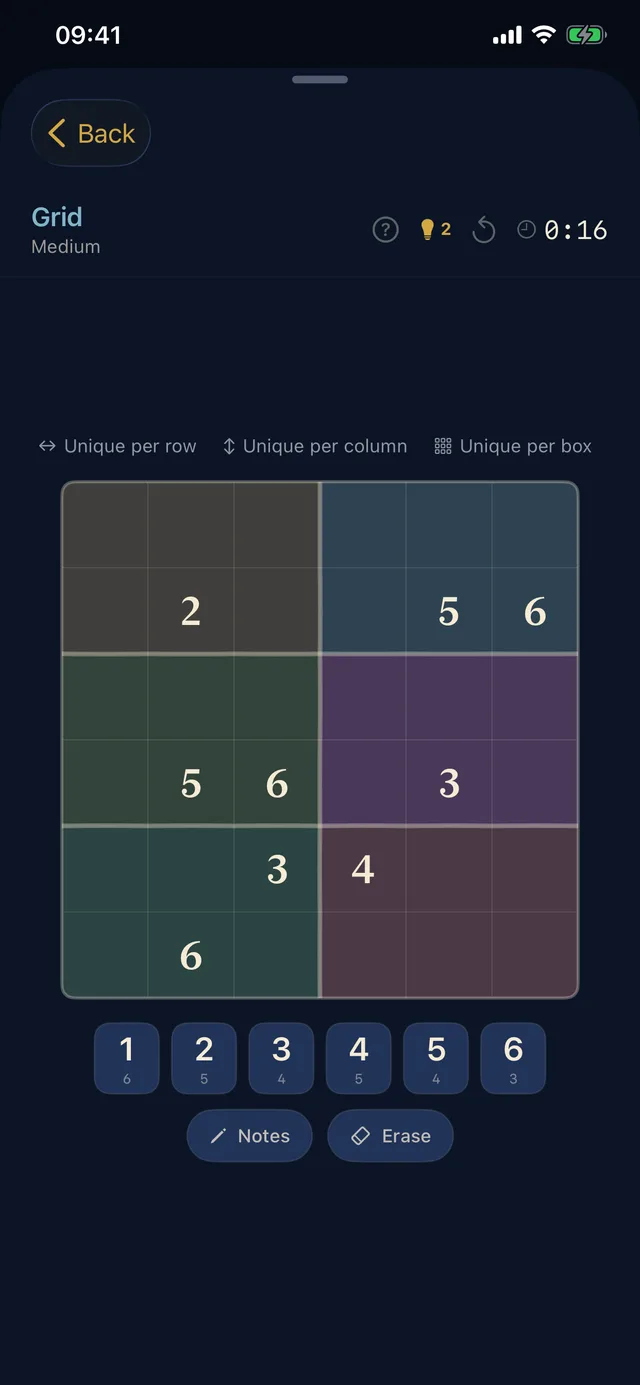
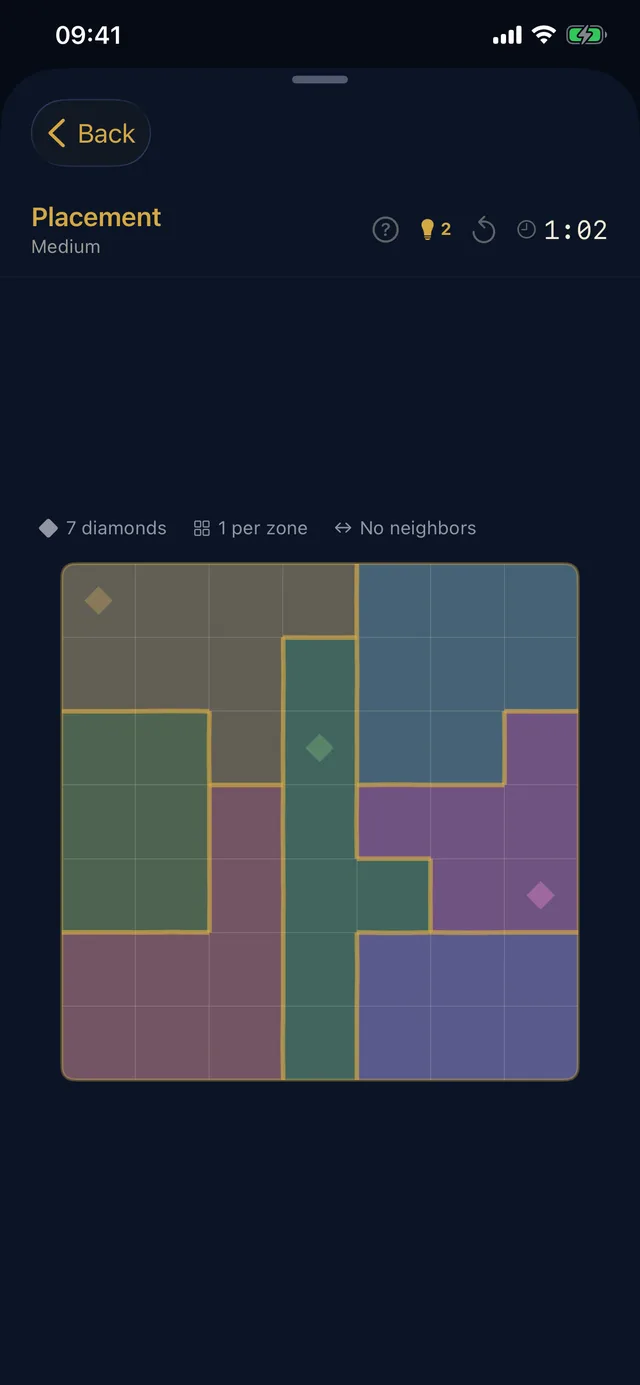

I made Tenkt for myself first, and I still open it over morning coffee. The method below is the one I use myself. It works just as well on the sudoku in the newspaper and on most other grid puzzles. Where the app saves you a step, it says so.
1. Read the rules as prohibitions
A grid puzzle has two or three rules, and they are all you have to go on. Read them as prohibitions. “Unique per row” means the same number cannot appear twice in a row. “One per zone” means the zone is closed once it has its one. Most moves come from what is not allowed.
In Tenkt: There are six types: Grid, Pathfinder, Placement, Balance, Connect and Area. In Grid, the numbers must be unique per row, column and box. In Placement, there is one diamond per row, column and colour zone.
2. Start with what is forced
Look for the cell that has only one possibility. Begin where the most is already filled in: the row that is nearly full, or the smallest zone. If a row is missing one number, that number is given. If a zone is a single cell, the piece must go there.
Fill in everything that is forced before you do anything else. Each move gives new information, and the next forced move is often right beside it.
3. Cross out what is impossible
Every time you fill something in, look at what it closes. A number closes the same number in the rest of its row, column and box. A diamond closes the rest of its row, column and zone.
It is usually easier to see where something cannot go than where it must go. When only one cell is left, it is forced, and you are back at step 2.
4. Look at rows, columns and zones one at a time
Ask two questions. The first is “what can go in this cell?”. The second is “where in this row can the four go?”. The second question finds moves the first one misses.
Work through one unit at a time: all the rows, then all the columns, then all the zones. Then look at where they overlap. If a whole zone lies inside one row, that row’s piece must be in that zone. The rest of the row is then closed.
5. Mark what you know
Your head cannot keep track of a whole board. Write small numbers in the corner of the cell for what is still possible, and put a cross where something is ruled out.
Mark only what follows from the rules. A note built on an assumption looks like a fact five minutes later.
6. Go back when you are stuck
If you are stuck, you have almost always overlooked something. Do not guess. Go through steps 3 and 4 again, one row, one column and one zone at a time. Check that your notes are correct as well.
If that does not help, you can try an assumption, but treat it as a proof. Assume the cell is 3, and follow the consequences. If it breaks a rule, you know the cell is not 3. That is logic, not guessing.
In Tenkt: All six types are solved with pure logic, no guessing. Traces, the currency you earn by playing, can be spent on extra hints and on undo.
7. Solve a little every day
The patterns repeat from board to board. The more you have solved, the faster you recognise a forced cell.
In Tenkt: Each day brings a new set of five to ten short puzzles, the same for everyone. Difficulty builds across the set. The app is free.
Common mistakes
- Guessing too early. A wrong guess ruins everything you build on top of it, and you notice late.
- Looking only at cells. Also ask where in the row, column or zone a piece can go.
- Forgetting one of the rules. It is usually the zone or the box that gets forgotten.
- Mixing notes and assumptions. Write down only what you know.
- Chasing the clock. Speed comes from recognising patterns, not from hurrying.